One full page in
Each model receives the complete drawing page as one image, with the same prompt. It returns labeled bounding boxes for five object types.
ARCHITECTURAL DRAWING BENCHMARK
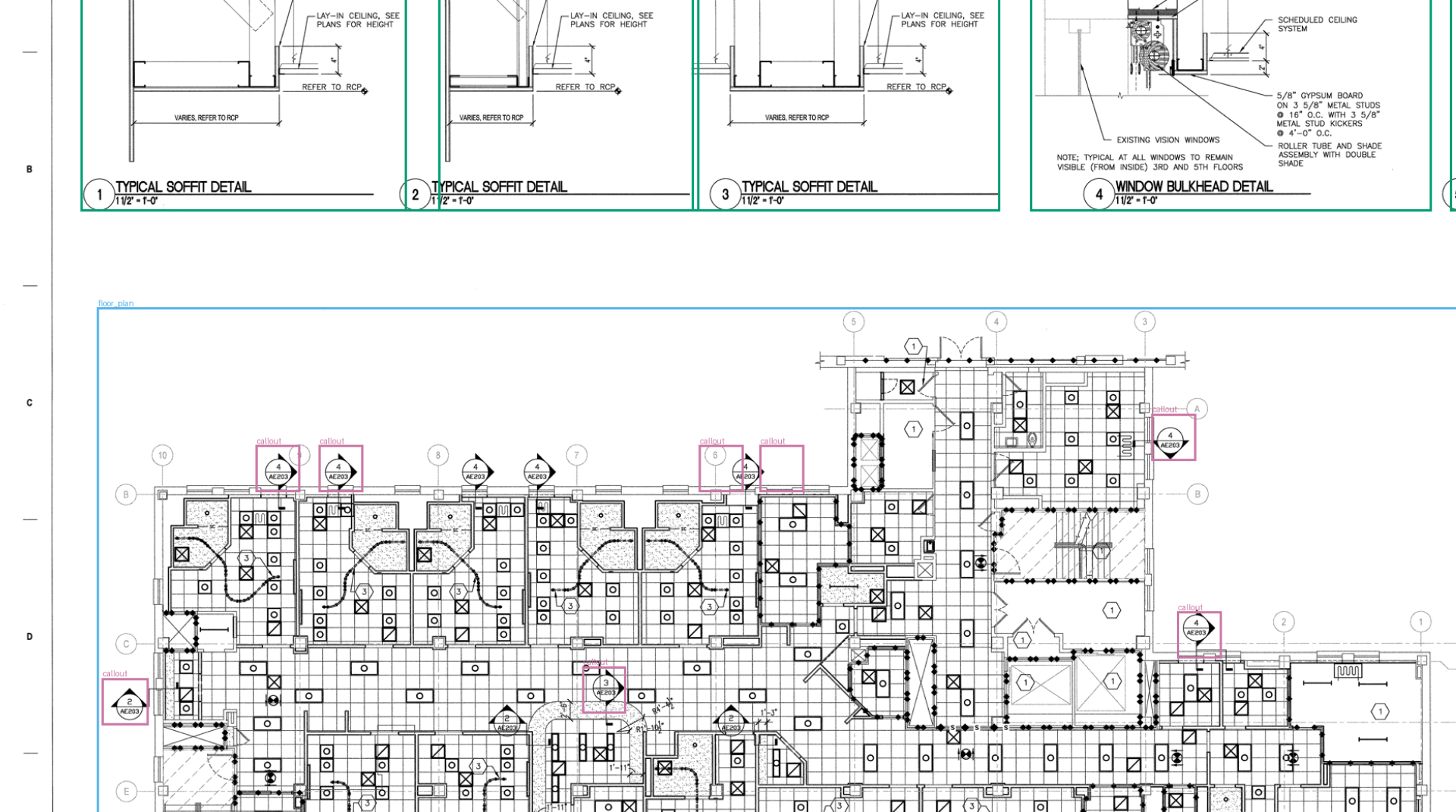
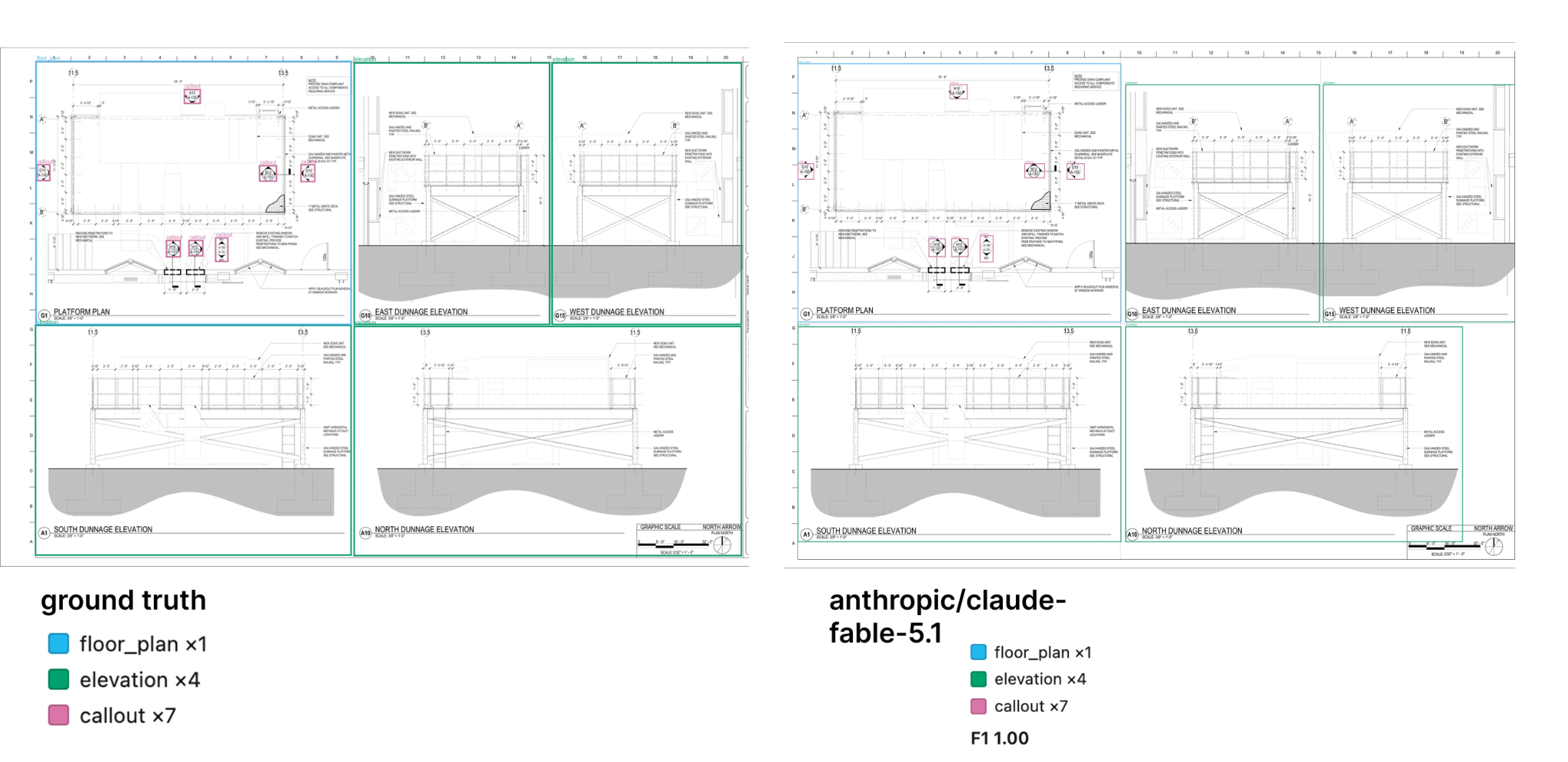
Each model receives the complete drawing page as one image, with the same prompt. It returns labeled bounding boxes for five object types.
The reference set contains 1,430 hand-labeled objects across nine publicly available projects. Pages range from one object to more than 60.
A predicted box must overlap its reference box sufficiently: intersection area divided by union area must reach 0.50.
Precision measures how many predicted boxes are correct. Recall measures how many reference objects were found. F1 combines both.
TP: matched boxes
FP: extra boxes · FN: missed objects
What 92% means. A 92% F1 score does not mean exactly 92% of objects were found, or that a takeoff is 92% complete.
Scope is specific. These are direct, full-page runs. Structured cropping pipelines and COXIT’s custom production systems are outside this leaderboard.
Drawing sets differ. Page density, object size, resolution, and scan quality affect performance. Rounded aggregate scores alone do not establish statistical significance.
Available evidence. The linked articles provide results and annotated examples. The downloads below contain aggregate results only; they do not include source drawings, annotations, or prompts. Recent releases include the API model identifiers from the evaluation export.
F1 balances correct detections, missed objects, and extra predictions. Scores run from 0 to 100; higher is better.
† Mistral Large 4.0: 117 of 119 pages processed. F1 retains all 1,430 ground-truth objects; cost and time summarize the 117 processed pages. The export does not identify the two missing pages.
Swipe across for all categories. Model names stay visible.
| Model | ||||||
|---|---|---|---|---|---|---|
01 GPT-6 AstraOpenAI | 92 | 82 | 84 | 99 | 94 | 96 |
02 Claude Opus 5.5Anthropic | 79 | 60 | 51 | 91 | 90 | 84 |
03 Gemini 4 ArgonGoogle | 76 | 69 | 38 | 91 | 75 | 81 |
| 04Gemini 3.8 FlashGoogle | 70 | 59 | 20 | 97 | 86 | 68 |
| 04Claude Fable 5.1Anthropic | 70 | 61 | 34 | 98 | 87 | 64 |
| 06GPT-5.6 SolOpenAI | 65 | 53 | 24 | 98 | 88 | 57 |
07 Qwen3.8-MaxAlibaba | 62 | 60 | 32 | 98 | 90 | 47 |
| 08GPT-6.1 SolOpenAI | 60 | 57 | 48 | 95 | 65 | 51 |
| 09GPT-5.6 TerraOpenAI | 56 | 51 | 23 | 94 | 87 | 38 |
| 10Gemini 3.5 FlashGoogle | 53 | 45 | 16 | 96 | 90 | 33 |
| 11Muse Spark 1.3Meta | 52 | 52 | 21 | 98 | 90 | 23 |
| 12Gemini 3.1 Pro PreviewGoogle | 51 | 39 | 10 | 89 | 78 | 37 |
| 12Claude Sonnet 5.5Anthropic | 51 | 48 | 34 | 96 | 80 | 30 |
| 14GPT-6 SolOpenAI | 49 | 25 | 11 | 96 | 83 | 36 |
| 15Claude Opus 5Anthropic | 40 | 51 | 19 | 96 | 89 | 15 |
16 Grok 4.6xAI | 30 | 5 | 7 | 91 | 69 | 0 |
| 17Mistral Large 4.0†Mistral AI | 27 | 14 | 3 | 78 | 64 | 2 |
| 18GPT-6 LunaOpenAI | 23 | 13 | 8 | 82 | 38 | 6 |
| 19Claude Sonnet 5Anthropic | 21 | 10 | 0 | 73 | 47 | 4 |
| 20Grok 4.7xAI | 20 | 3 | 0 | 81 | 44 | 0 |
Overall F1 is pooled across all objects. It is not an average of the five category scores.
0–100 F1Source: COXIT’s October 16, 2026 results export. V5 adds Gemini 4 Argon (76%) and Mistral Large 4.0 (27%), computed from pooled TP/FP/FN counts at IoU 0.50 and rounded to whole percentages. The previous 18 model records are unchanged. Sample results are excluded.
Each line shows a lab’s highest F1 in each published edition.
Dates refer to benchmark editions, not model launches. Each point uses the models listed in that edition; the leading model can change by category. A flat line means the best published score is unchanged, not that the model was tested again. Scores are rounded; lines do not represent measurements between editions. † Mistral’s v5 result has 117 of 119 pages processed, with the full ground-truth denominator retained.
| Model | ||
|---|---|---|
| GPT-6 Luna | 29.5 s | |
| Gemini 4 Argon | 9.8 s | |
| Claude Sonnet 5.5 | 5.5 s | |
| Muse Spark 1.3 | 38.4 s | |
| Gemini 3.5 Flash | 15.5 s | |
| Gemini 3.1 Pro Preview | 19.2 s | |
| Claude Opus 5.5 | 8.9 s | |
| Mistral Large 4.0† | 206.8 s | |
| Qwen3.8-Max | 154.9 s | |
| GPT-5.6 Terra | 32.0 s | |
| GPT-5.6 Sol | 45.2 s | |
| GPT-6.1 Sol | 25.8 s | |
| GPT-6 Sol | 24.3 s | |
| Gemini 3.8 Flash | 100.1 s | |
| Claude Sonnet 5 | 60.8 s | |
| Grok 4.7 | 185.9 s | |
| Claude Opus 5 | 37.2 s | |
| Grok 4.6 | 331.9 s | |
| Claude Fable 5.1 | 22.3 s | |
| GPT-6 Astra | 28.2 s |
The paper covers the September 2026 evaluation of 14 models. The leaderboard includes subsequent benchmark updates.
COXIT. CaseVBench: AI Architectural Drawing Benchmark. v5, October 16, 2026. F1 at IoU 0.50; 119 pages, 1,430 annotated objects, nine projects. https://casevbench.com/
Research by COXIT in partnership with LVL10. This site presents the published results; the original benchmark and methodology article provide the source context. Cite the release and metric alongside any score.
Versioned score tables. V5 includes API identifiers, per-model measurement months and processed-page counts, with partial coverage and promotional discounts noted. V1–v4 remain archived as originally published.
The October export matches the earlier benchmark scope and prior aggregate records. It does not provide dataset or evaluator version hashes, run IDs, prompts, or raw per-page cost and latency records, so full run reproducibility is not established.
Read the September analysis and inspect annotated drawing examples on COXIT.
The original six-model results examine localization errors, project variation, and a looser IoU threshold.
The research question, image-resolution constraints, and the distinction between direct and structured processing.